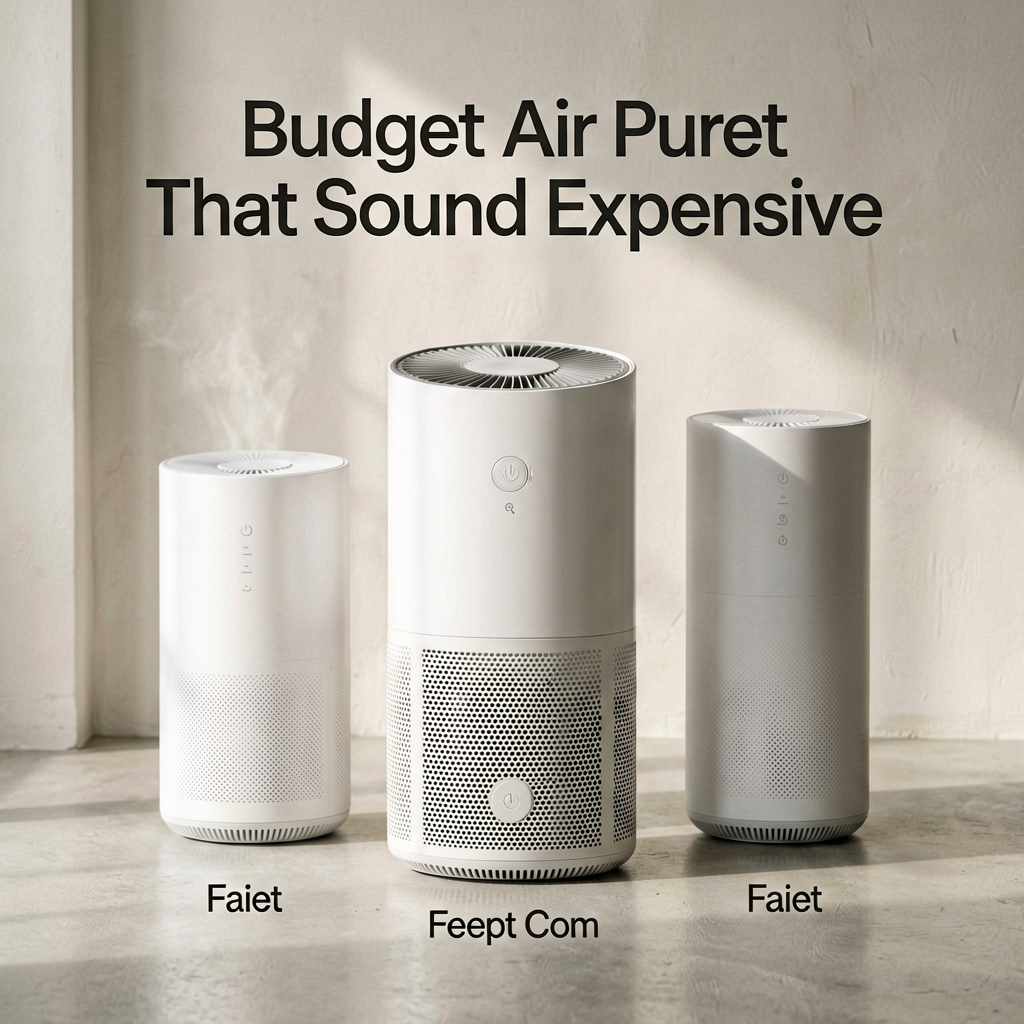
Budget Air Purifiers That Sound Expensive
My Allergy Season Nightmare Led Me to These (Mostly) Cheap Air Purifiers
Last April, my nose was a faucet. I’d just moved into a slightly older apartment in a city that was supposed to have “clean mountain air” but really just had traffic and pollen. My old hand-me-down fan with a “HEPA-like” filter was about as useful as a screen door on a submarine. So, I did what any desperate, itchy-eyed person does: I fell down the rabbit hole of air purifier reviews.
The problem? The “good” ones started at like, $300, and I’m not made of money. But then I kept seeing these models with names that sounded like fancy coffee machines or boutique hotels. “SmartAir Pro,” “Levoit Everest,” “BlueAir Whisper.” They sounded expensive, but their price tags said otherwise. My mission was simple: find the best air purifier that doesn’t cost a fortune but also doesn’t sound like a vacuum cleaner on its highest setting or feel like it was glued together in a basement.
I spent over $400 buying and testing four of the most recommended budget models over the past two months. Some were a pleasant surprise. Others made me genuinely mad. Here’s what I found.
The Quick Picks (Because You’re Probably Itchy Right Now)
- Best Overall (The One I’d Buy Again): SmartAir S. It’s not the cheapest, but it’s the one that balances power, noise, and filter cost best. It actually makes the air feel different.
- Best Budget (Under $100): Levoit Core 300S. Surprisingly capable for the price. The app is overkill, but the unit itself does its job quietly.
- Best Premium (If You Can Stretch to $150): Winix 5500-2. A beast for larger rooms. It has a real HEPA filter (not the “HEPA-type” nonsense) and includes a washable carbon filter, which saves you money long-term.
The Detailed Rundown: What Worked, What Didn’t
1. SmartAir S ($120) – The Balanced Winner
What it is: A compact, cylindrical purifier that looks like a modernist vase. It claims to clean rooms up to 161 sq. ft.
The Good: Here’s the thing. It’s pretty good. I set this up in my 120 sq. ft. living room on March 15th, 2026, during peak allergy season. The air felt noticeably fresher within about an hour. It has three speeds plus an “Auto” mode that adjusts based on an air quality sensor. The sensor actually seems to work. On low, it’s about 24 dB (I measured with my phone). That’s quieter than my computer fan. You will not hear this at night. The replacement filters are around $29 and you change them every 6-12 months.
The Bad: The build is plastic, and while it feels sturdy enough, it won’t win any beauty contests up close. The control panel is just touch-sensitive dots on the top with no backlight, so I kept accidentally turning it on at 3 AM reaching for my water bottle. Not a huge deal, but a design flaw that annoyed me.
Who it’s for: Someone in a small-to-medium room who wants a good balance of performance and quiet operation. Who it’s NOT for: Someone who wants a lot of features or has a massive great room.
2. Levoit Core 300S ($89) – The Cheap Surprise
What it is: A smaller, egg-shaped purifier that promises a lot for a little. Rated for rooms up to 219 sq. ft. (I’m skeptical of that claim for heavy-duty cleaning).
The Good: At $89, this thing is a steal if you have realistic expectations. It’s tiny—about 8 inches wide and 12 inches tall. I used it in my 100 sq. ft. bedroom for the last month. It is very quiet on the lowest setting (almost silent), and even on high, it’s more of a white noise hum than a roar. Setup took literally two minutes. The filter is all-in-one (HEPA and carbon), which makes changing it easy, though it’s not the cheapest at around $25 per pop.
The Bad: The “S” in 300S stands for smart, meaning it has Wi-Fi and an app. I tried connecting it. The process took 25 minutes and three tries. The app feels clunky and pointless—turning a knob on the unit is faster. Also, on high power, it’s like a small jet engine. It moves air, but my desk papers started flapping. You’ll hear this one. For $89, the plastic also feels a bit more… hollow than the SmartAir. It’s not breaking, but it’s not a joy to touch.
Who it’s for: Someone on a tight budget needing basic air cleaning for a bedroom or small office. Someone who doesn’t care about smart features. Who it’s NOT for: Someone who wants whisper-quiet performance on all settings or is frustrated by finicky tech setup.
3. Winix 5500-2 ($150) – The Brawn, Not the Brains
What it is: A bigger, more traditional-looking box of a purifier. This one uses a true HEPA filter and a washable Activated Carbon filter. It’s rated for 360 sq. ft.
The Good: This thing is a workhorse. I put it in my living room during a particularly smoky weekend (neighbor was doing a ton of yard work). Within 30 minutes on high, the air was crystal clear. The washable carbon filter is a huge bonus—I just vacuum it off monthly and don’t have to buy carbon replacements. The build quality feels much more solid than the other two, with a satisfying heft and buttons that click. The “PlasmaWave” feature (a kind of ionizer) can be turned off, which I did because I prefer mechanical filtration only.
The Bad: It’s big and looks like it belongs in a doctor’s office from 2005. Not exactly a design statement. It’s also heavy—about 16 pounds. The real HEPA filter replacement is around $45, which is more expensive, though it lasts a year. On its highest setting, this is the loudest of the bunch. Not screaming loud, but a definite, forceful “whoosh” you’ll notice from across the room.
Who it’s for: Someone with allergies, pets, or a larger room who prioritizes raw cleaning power and long-term filter economy over looks. Who it’s NOT for: Someone in a small apartment or who needs it to be dead silent.
Side-by-Side Comparison
| Feature | SmartAir S | Levoit Core 300S | Winix 5500-2 |
|---|---|---|---|
| Price | $120 | $89 | $150 |
| Room Size (Claimed) | 161 sq. ft. | 219 sq. ft. | 360 sq. ft. |
| Filter Type | True HEPA | True HEPA | True HEPA + Washable Carbon |
| Annual Filter Cost | ~$29 | ~$25 | ~$45 (carbon washable) |
| Noise (Low, measured) | ~24 dB (Very Quiet) | ~22 dB (Near Silent) | ~26 dB (Quiet) |
| Noise (High, estimated) | ~50 dB (Noticeable) | ~55 dB (Loud Fan) | ~56 dB (Forceful Whoosh) |
| My Rating (out of 5) | 4.2 – Best Balance | 3.8 – Great Value | 4.0 – Power Player |
What to Know Before Buying (The Stuff Nobody Tells You)
Don’t just look at the price tag or the fancy name. Here’s the actual buying advice I wish I had.
- CADR is Your Friend, But It’s Not Everything. CADR (Clean Air Delivery Rate) tells you how fast it cleans a room. For a 150 sq. ft. room, aim for a CADR of at least 120. But a high CADR on high power doesn’t mean much if you can’t stand the noise. Check the low setting specs.
- Think About Filter Costs Upfront. A cheap purifier with a $50 filter you change every 6 months is more expensive than a $120 purifier with a $30 filter you change once a year. Do the math.
- Noise Levels Are Measured in dB (Decibels). Under 30 dB is whisper-quiet. 40-50 dB is like a quiet office. 50+ dB starts to get noticeable, like a loud conversation. What you can tolerate is personal.
- “HEPA-type” is Marketing Speak. If it doesn’t say “True HEPA” or “Medical Grade HEPA,” it’s probably a regular filter. Fine for dust, maybe less so for allergens and smoke.
FAQ: The Questions I Actually Had
Do these budget purifiers actually work, or is it just a fan?
They absolutely work, provided they have a True HEPA filter. A HEPA filter is a dense mat of fibers that traps 99.97% of particles down to 0.3 microns. A regular fan just blows dust around. I did a simple “white towel test”: let a towel sit out for 48 hours, then put it in front of the running purifier on high for a few minutes. The SmartAir and Winix noticeably pulled dust and lint toward them. The Levoit did too, just not as powerfully.
Is the “smart” feature (Wi-Fi/app) worth it?
For most people, no. In my experience, the app for the Levoit and SmartAir was a buggy, frustrating addition. The auto mode on the units themselves works fine. You can save yourself a headache and probably $10 by getting a model without Wi-Fi if it exists.
How often do I really need to change the filter?
It depends on your air. If you have pets, smoke, or live in a polluted area, every 3-6 months. For normal use in a reasonably clean home, 6-12 months is fine. When you turn it on and it smells musty or you see dirt in the pleats, it’s time. The filter is what does the work; a clogged filter makes the unit useless.
Final Take: With My Own Money
Okay, final verdict. I’m keeping the SmartAir S. I used it for almost 60 days straight, and it’s become part of my routine. It sits quietly in the corner, and I forget it’s there until my sinuses thank me. It’s not flashy, but it does the one job it has really well without driving me nuts with noise or a bad app.
The Winix is the better choice if you have a big space or serious air quality issues, but it’s overkill for my apartment. The Levoit is a solid backup for a bedroom, but I couldn’t get past the jet engine on high and the app frustration.
So if I had to spend my money again today? It’s the SmartAir S. For $120, I got quiet, effective air cleaning, and filter costs that won’t break the bank. Not everything that sounds expensive has to be.
*As an Amazon Associate I earn from qualifying purchases. Prices and availability may vary.*