Overnight Oats: 5 Ways to Prep Breakfast All Week
Overnight oats transform a simple grain into a structured, nutrient-dense meal prep breakfast through controlled hydration and enzymatic breakdown. This method works because cold liquid slowly penetrates the oat endosperm, softening the bran without dissolving the starch matrix. The result is a consistent, spoonable texture that holds up to refrigeration for up to five days. This recipe is designed for beginners but relies on professional precision in ratios and timing. Mastering the base formula ensures repeatable results, while the five flavor variations provide rotating profiles without altering the core technique. You will learn how to balance liquid-to-grain ratios, manage chia hydration, and layer ingredients for optimal texture retention. This easy breakfast protocol guarantees a reliable start to your day.
What You’ll Need
Base Ingredients (Per Serving / Per Jar)
- 1/2 cup (40g) old-fashioned rolled oats: Must be thick-cut for structural integrity. Quick oats will disintegrate; steel-cut oats will remain too hard.
- 1/2 cup (120ml) whole milk or unsweetened soy milk: Minimum 3% fat content ensures proper mouthfeel and emulsification.
- 1 tablespoon (10g) chia seeds: Acts as a hydrocolloid thickener. Fresh seeds should pour freely without clumping.
- 1/8 teaspoon (0.75g) fine sea salt: Enhances flavor perception and balances sweetness.
- 1 tablespoon (15g) pure maple syrup or agave: Provides hygroscopic sweetness that retains moisture during storage.
Flavor Variations (Add to Base Per Jar)
- Berry Almond: 2 tablespoons (18g) sliced almonds, 1/4 cup (35g) frozen mixed berries
- Cocoa Hazelnut: 1 tablespoon (6g) unsweetened cocoa powder, 2 teaspoons (10g) hazelnut butter
- Tropical Coconut: 1/4 cup (30g) unsweetened coconut flakes, 1/4 cup (60g) diced mango
- Spiced Apple: 1/4 cup (30g) finely diced Fuji apple, 1/4 teaspoon (0.5g) ground cinnamon
- Espresso Mocha: 1/4 cup (60ml) cold brew concentrate (replaces equal milk volume), 1 teaspoon (2g) vanilla bean paste
Equipment
- Five 16oz wide-mouth glass jars with airtight lids
- Digital kitchen scale (0.1g precision) [Check Price on Amazon]
- Small wire whisk or mini silicone spatula
- 12-inch rimmed baking sheet (for optional oat toasting)
Prep Work
Proper preparation prevents separation and ensures uniform hydration across all five jars. Weigh all dry ingredients using the digital scale to eliminate volumetric inconsistencies. Scoop oats directly into each jar, then level with the back of a spoon. Toasting is optional but recommended: spread 2.5 cups (200g) total oats on the 12-inch baking sheet and bake at 350°F / 177°C for 6 minutes until the grain releases a nutty aroma and turns pale golden. Cool completely to room temperature (68°F / 20°C) before sealing. Cold oats will condense moisture and promote premature spoilage.
Prepare the liquid component by combining milk, salt, and sweetener in a 1-quart liquid measuring cup. Whisk vigorously for 30 seconds until fully integrated. Measure chia seeds separately; store them in a dry, airtight container until use. Moisture exposure causes premature gelling. All add-ins should be pre-portioned into small ramekins for rapid assembly. The entire prep sequence takes 12 minutes active time. You can complete this step up to 4 hours before assembly if ingredients remain covered at 40°F / 4°C or below.
Assembly & Hydration Instructions
While overnight oats do not require heat, the hydration process demands precise temperature control and timing to achieve the correct viscosity.
- Layer Dry Base: Add 1/2 cup (40g) rolled oats and 1/8 teaspoon fine sea salt to each of the five jars. Ensure the oats sit flat on the bottom to prevent air pockets.
- Incorporate Chia: Sprinkle exactly 1 tablespoon (10g) chia seeds evenly over the oats. Distribute them in a circular pattern to prevent localized clumping during mixing.
- Add Liquid & Sweetener: Pour 1/2 cup (120ml) of the prepared milk mixture into each jar. Use a mini silicone spatula to scrape the measuring cup completely; residual liquid alters the hydration ratio. Insert the spatula to the bottom and stir in 15 firm, clockwise rotations until no dry pockets remain.
- Integrate Flavor Profiles: Fold in the designated variation ingredients. For the Berry Almond and Tropical Coconut jars, press add-ins gently into the middle layer to prevent them from floating to the surface during refrigeration. For the Espresso Mocha, reduce the milk to 1/4 cup (60ml) and add 1/4 cup (60ml) cold brew to maintain the exact 1:1 liquid-to-oat volume.
- Seal & Refrigerate: Secure lids tightly and place jars upright in the refrigerator at 36°F–40°F / 2°C–4°C. Hydration requires exactly 8–12 hours. Do not disturb for the first 2 hours; this allows the chia mucilage to form a continuous gel network without disruption.
- Final Integration: After 8 hours, remove jars and check consistency. Properly hydrated healthy oats will appear plump, glossy, and uniformly suspended in a thickened liquid. If the mixture appears dry, stir in 1 teaspoon (5ml) milk per jar. If it pools excess liquid on top, gently fold once and rest for 15 minutes at 68°F / 20°C to allow reabsorption.
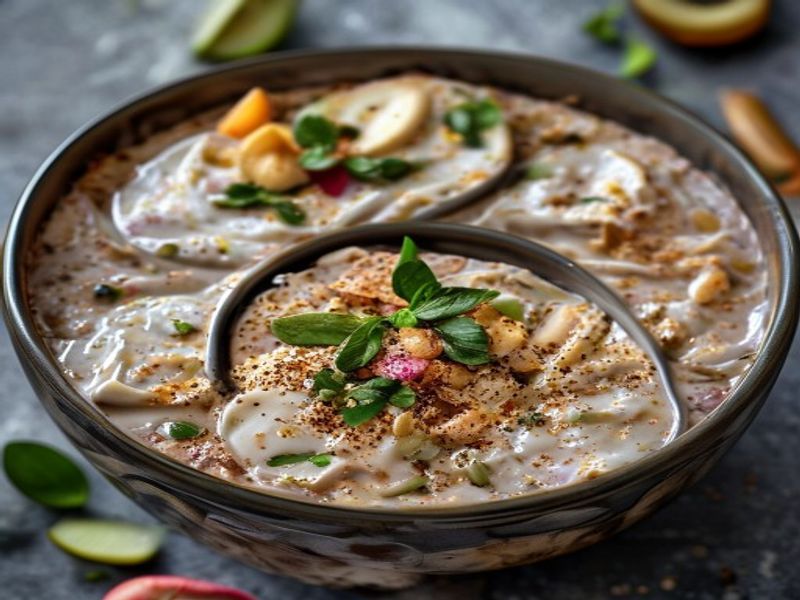
Visual & Texture Cues: The oats should yield slightly to gentle pressure from a spoon but retain distinct shape. Chia seeds will appear translucent with a gelatinous halo. The surface should show a smooth, cohesive sheen, not a separated watery layer.
Common Mistakes to Avoid: Over-stirring during the first 2 hours fractures the chia gel, resulting in a grainy, runny texture. Using quick oats causes the starch to fully dissolve, creating a paste rather than distinct grains. Skipping the salt step flattens the flavor profile, making the sweetener taste one-dimensional.
Pro Tips
Temperature stability is the most overlooked factor in overnight oat success. I find that storing jars in the main compartment of the refrigerator, rather than the door, maintains a consistent 38°F / 3°C environment that prevents condensation cycling and texture breakdown. In my experience, fat content directly correlates to mouthfeel; substituting skim milk or low-fat yogurt without adding 1/2 teaspoon of neutral oil results in a chalky finish. If you prefer a thicker, spoon-standing consistency, increase chia to 1.5 tablespoons per batch and reduce milk to 1/3 cup (80ml) initially.
For substitutions, Greek yogurt can replace 1/4 cup (60ml) of the milk, but it must be tempered by whisking it with 1 tablespoon of warm water first to prevent curdling upon contact with cold liquid. You can prep the dry base up to 3 days in advance if stored in a vacuum-sealed container away from humidity. Add wet components only when ready to hydrate to preserve ingredient integrity.
Serving Suggestions
Each 16oz jar yields a single, complete serving of approximately 380 calories, balanced across complex carbohydrates, 9g of protein, and 11g of dietary fiber. Serve chilled directly from the refrigerator. For optimal texture, let the jar sit at room temperature (68°F / 20°C) for 10 minutes before eating to soften the chilled fats. Top with 1 tablespoon (15g) freshly ground nut butter or 2 tablespoons (15g) toasted seeds immediately before consumption to preserve crunch. Pair with an 8oz black coffee or green tea; the acidity cuts through the creamy base and enhances nutrient absorption. Portion guidance remains strict at one jar per serving to maintain the calibrated macronutrient profile.
FAQ
Can I use quick oats instead of rolled oats?
No. Quick oats are pre-steamed and rolled thinner, which causes them to fully disintegrate during the 8-hour hydration window. This produces a mushy, homogenous slurry rather than the distinct, tender grains required for a professional healthy oats preparation. Always use old-fashioned rolled oats for structural retention.
How do I know when the oats are properly hydrated?
Press the back of a spoon into the mixture. The oats should compress easily without resistance but spring back slightly when released. Visually, the liquid will be fully absorbed into a thick, uniform gel with no free pooling. If the mixture feels gritty or dry, it needs an additional 2 hours at 40°F / 4°C.
Can I freeze these for longer storage?
Freezing is not recommended. The water content expands during crystallization, rupturing the oat cell walls and breaking the chia gel matrix. Upon thawing, the texture becomes watery and grainy. For extended storage beyond 5 days, portion the dry mix into airtight containers and add liquid only 24 hours before consumption.
Why does my separation occur after 3 days?
Slight weeping is normal due to osmotic pressure from the sweetener drawing moisture outward. Simply stir vigorously for 10 seconds to re-emulsify. If separation is severe, the refrigerator temperature likely fluctuated above 45°F / 7°C, accelerating starch retrogradation and liquid expulsion.
*As an Amazon Associate I earn from qualifying purchases.
发表回复