Introduction
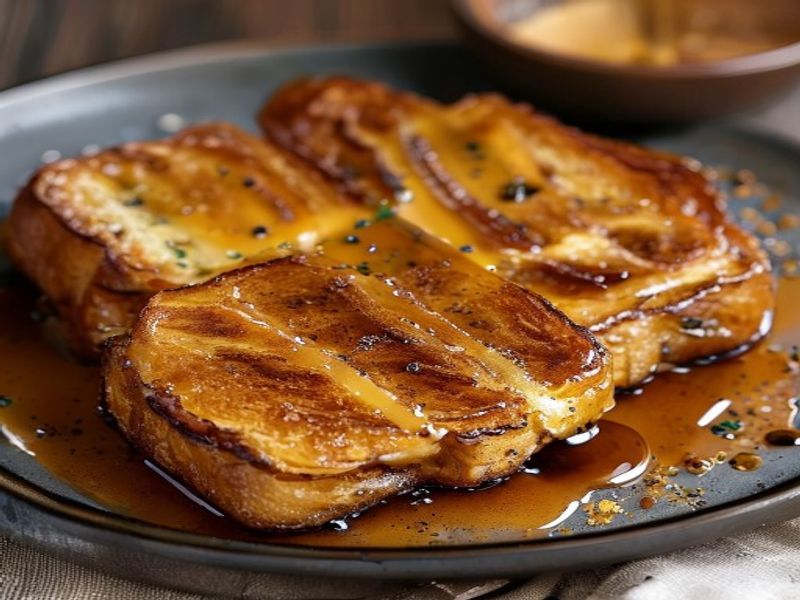
This pan fried french toast recipe delivers restaurant-quality results in under ten minutes by leveraging brioche’s high fat content and a controlled thermal approach. The bread’s enriched crumb absorbs custard without collapsing, while a properly heated skillet creates a rapid Maillard reaction that seals moisture inside. This brioche french toast recipe is engineered for reliability, making it one of the most effective 10 minute breakfast ideas for weeknights or weekends. The technique requires intermediate heat management, but the payoff is consistent: a caramelized exterior, custardy center, and a balanced brown butter cinnamon syrup with aromatic cardamom notes. Follow the exact temperatures, timing, and visual cues outlined below to eliminate guesswork and guarantee repeatable results for family friendly morning meals.
What You’ll Need
Ingredients
- 1 loaf (16 oz / 450 g) day-old brioche, sliced 1-inch (2.5 cm) thick
- 3 large eggs (approx. 150 g without shells), cold
- 1/2 cup (120 ml) whole milk, chilled
- 2 tablespoons (30 g) granulated sugar
- 1 teaspoon (5 ml) pure vanilla extract
- 1/4 teaspoon fine sea salt
- 4 tablespoons (56 g) unsalted butter, divided (2 tbsp for frying, 2 tbsp for syrup)
- 1/4 cup (60 ml) heavy cream
- 3 tablespoons (38 g) packed dark brown sugar
- 1/2 teaspoon ground cinnamon
- 1/4 teaspoon ground cardamom
- Pinch of freshly ground black pepper
Equipment
- 12-inch heavy-bottomed cast iron or nonstick skillet (Check Price on Amazon)
- 9×5-inch shallow baking dish or pie plate
- 10-inch wire whisk
- Instant-read thermometer
- Offset spatula
- Wire cooling rack set over a sheet pan
Prep Work
Proper mise en place dictates the success of skillet breakfast ideas. Execute the following steps before applying heat:
- Bread Preparation: Slice brioche to exactly 1-inch (2.5 cm) thickness using a serrated knife. If using fresh bread, arrange slices on a wire rack at room temperature for 45 minutes to allow surface moisture to evaporate. This structural drying prevents the custard from turning the crumb into mush.
- Custard Assembly: Combine 3 cold eggs, 1/2 cup whole milk, 2 tablespoons granulated sugar, 1 teaspoon vanilla extract, and 1/4 teaspoon fine sea salt in a shallow dish. Whisk vigorously for 60 seconds until completely homogenous and slightly aerated. Keep refrigerated at 40°F / 4°C until the moment of soaking to control starch hydration.
- Syrup Components: Pre-measure 2 tablespoons unsalted butter, 1/4 cup heavy cream, 3 tablespoons dark brown sugar, 1/2 teaspoon cinnamon, 1/4 teaspoon cardamom, and a pinch of black pepper into a small bowl. Having them ready prevents burning during the rapid syrup reduction phase.
Timing Notes: This make ahead breakfast component allows the custard base to be whisked and refrigerated for up to 48 hours. Brioche can be sliced and stored in a zip-top bag at room temperature overnight for optimal crumb structure. Do not combine the custard and bread until you are ready to cook.
Cooking Instructions
- Heat the Skillet: Place a 12-inch heavy-bottomed skillet over medium heat. Add 1 tablespoon (14 g) unsalted butter. Heat until the butter melts, foams, and then subsides, approximately 2 minutes. Target surface temperature: 325°F / 163°C. Test with a single drop of water; it should sizzle and evaporate instantly without skittering.
- Soak the Brioche: Pour the chilled custard into the 9-inch shallow dish. Submerge each slice for exactly 15-20 seconds per side. Press the bread gently with your fingertips to encourage capillary action without tearing the crust. Remove and hold above the dish for 5 seconds to drain excess liquid. Why this matters: Over-soaking causes structural failure; under-soaking leaves dry, unseasoned pockets.
- Pan-Fry the First Batch: Lay 3 slices in the preheated skillet, leaving 1/2-inch gaps. Cook undisturbed for 3 minutes 30 seconds. Visual cue: edges turn deep golden brown, and the bottom releases cleanly when slid under with an offset spatula. If the butter smokes before 2 minutes, your heat is too high—reduce to medium-low immediately.
- Flip and Finish: Flip slices carefully. Cook for 2 minutes 30 seconds on the second side until uniformly browned and the center reaches 165°F / 74°C on an instant-read thermometer. Transfer immediately to a wire rack set over a sheet pan. Wipe the skillet with a dry paper towel, add 1 tablespoon (14 g) fresh butter, and repeat for the final 3 slices. Total active cooking time: 10 minutes.
- Build the Syrup: While the second batch fries, combine all syrup ingredients in a small saucepan over medium-low heat (275°F / 135°C). Whisk continuously for 3 minutes until the brown sugar dissolves and the emulsion thickens. The mixture will coat the back of a spoon and leave a clean trail when dragged with a spatula. Remove from heat immediately to prevent sugar crystallization.
- Common Mistakes to Avoid: Never overcrowd the pan; it drops surface temperature below 300°F / 149°C, causing steam instead of a crust. Avoid high heat entirely; brioche’s sugar content burns rapidly above 350°F / 177°C. Skip the wire rack after cooking—trapping condensation on a flat plate guarantees a limp bottom crust.
Pro Tips
- Bread Selection: If brioche is unavailable, use challah or Texas toast. Avoid standard sandwich bread; its low fat content and tight crumb structure will not absorb custard evenly and will tear during frying.
- Heat Management: I find that maintaining consistent pan temperature requires resetting heat between batches. Let the skillet cool for 45 seconds, wipe with a dry paper towel, and reapply fresh butter. This prevents polymerized butter from turning bitter and ensures a clean, even crust on every slice.
- Cardamom Bloom: Toast the ground cardamom in a dry pan for 10 seconds before adding it to the syrup. In my experience, this volatile oil release amplifies the floral notes and prevents a gritty, raw spice finish. This cardamom french toast technique elevates the dish from basic to professional.
- Make-Ahead Option: For quick brunch recipes that scale, pan-fry a full batch until 90% done, cool completely on a rack, and freeze in a single layer. Reheat directly from frozen in a 375°F / 190°C oven for 8-10 minutes. Finish with a 1-minute skillet refresh to restore the crust.
- Substitutions: For a dairy-free version, swap whole milk for oat milk and butter for refined coconut oil. The syrup works identically with pure maple syrup replacing brown sugar, though viscosity will be thinner and cooking time reduced by 45 seconds.
Serving Suggestions
Serve immediately while the crust is crisp and the center is warm (140°F / 60°C+). Each 1-inch slice yields a 4-ounce portion; plan 2 slices per adult and 1.5 slices per child for an easy weekend breakfast. Pair with high-acid elements to cut the richness: fresh blackberries, sliced Granny Smith apples, or a light dollop of 2% Greek yogurt. Avoid heavy whipped creams that mask the brown butter and cardamom notes. For beverage pairings, a medium-roast Ethiopian pour-over or a lightly oxidized oolong tea complements the spice profile without competing.
FAQ
Can I use frozen brioche for this recipe?
Yes, but thaw slices completely on a wire rack at room temperature for 60-90 minutes before soaking. Frozen bread retains too much internal moisture, which causes violent oil spatter and prevents proper custard absorption.
How do I know when the French toast is done?
The exterior should be uniformly deep golden brown with a crisp, audible snap when tapped with a spatula. Internally, an instant-read thermometer inserted into the thickest part should read 165°F / 74°C, indicating the egg proteins have fully set without curdling.
Can I prep the custard and syrup ahead of time?
Absolutely. The custard can be whisked and refrigerated for up to 48 hours. The syrup can be prepared up to 5 days in advance; gently reheat over low heat (250°F / 121°C) for 2 minutes until pourable. Stir vigorously to re-emulsify if separation occurs.
Why does my French toast turn out soggy?
Sogginess typically results from three factors: bread that is too fresh, soaking times exceeding 30 seconds per side, or resting on a flat plate instead of a wire rack. Ensure your brioche is day-old, maintain strict 15-20 second soak windows, and always drain on elevated wire racks to allow steam to escape.
*As an Amazon Associate I earn from qualifying purchases.
发表回复