Introduction
This air fryer french toast delivers a shatteringly crisp exterior and a custard-rich center by leveraging rapid convection heat instead of heavy pan-frying. Using a sturdy, slightly stale loaf creates the ideal structure for a sourdough french toast recipe that holds up to a generous maple pecan glaze without turning soggy. The technique is designed for a quick weekend brunch, offering elevated morning meals without the grease or babysitting required by traditional stovetop methods. This approach is perfect for intermediate home cooks ready to master custard absorption and controlled browning. You will achieve consistent, restaurant-quality results with precise temperature control and a streamlined workflow.
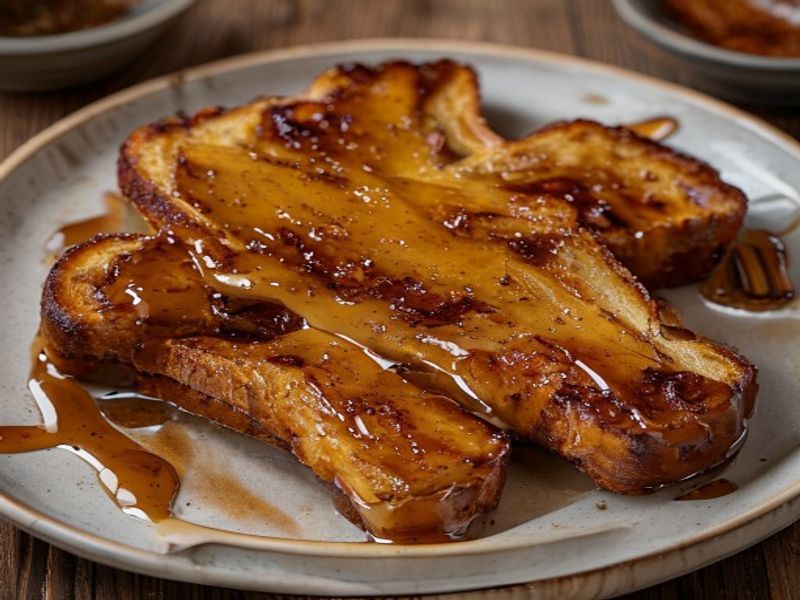
What You’ll Need
Ingredients
- Sourdough bread: 8 slices, exactly 1-inch thick, cut from a day-old loaf (drier crumb prevents structural collapse)
- Large eggs: 4 whole, at room temperature for smooth emulsification
- Whole milk: 1 cup (240 ml), cold
- Heavy cream: 1/2 cup (120 ml), cold (fat content ensures rich custard)
- Pure vanilla extract: 2 teaspoons (5 ml)
- Ground cinnamon: 1 teaspoon (2 g), freshly sifted
- Fine sea salt: 1/4 teaspoon (1.5 g), enhances sweetness
- Unsalted butter: 6 tablespoons (85 g), cut into 4 pieces, chilled
- Pure maple syrup: 1/2 cup (120 ml), Grade A dark amber preferred
- Pecans: 1 cup (115 g), roughly chopped into 1/2-inch pieces
Equipment
- 5-quart basket-style air fryer with adjustable temperature control
- 13 x 9-inch shallow glass or ceramic baking dish (for soaking)
- 1-quart heavy-bottomed saucepan (for browning butter)
- Fine-mesh strainer (10-inch diameter)
- Instant-read digital thermometer
- Wide silicone pastry brush
- Check Price on Amazon for 12-inch stainless steel whisk
Prep Work
Proper mise en place dictates the success of any easy air fryer breakfast. Remove eggs from the refrigerator 30 minutes before starting. Cold eggs emulsify poorly and create uneven custard distribution. Lay sourdough slices flat on a wire rack to air-dry for 15 minutes if using fresh bread; the surface should feel slightly leathery to the touch. Chop pecans uniformly to ensure even toasting in the glaze. The custard can be whisked and strained up to 2 hours in advance, but store it covered in the refrigerator at 38°F / 3°C to prevent bacterial growth and protein breakdown. Do not combine wet and dry components until you are ready to cook, as prolonged soaking destroys the bread’s structural integrity.
Cooking Instructions
- Prepare the custard: Crack 4 large eggs into a mixing bowl. Add 1 cup (240 ml) whole milk, 1/2 cup (120 ml) heavy cream, 2 teaspoons vanilla extract, 1 teaspoon ground cinnamon, and 1/4 teaspoon fine sea salt. Whisk vigorously for 45 seconds until the mixture is pale yellow and completely homogenous. Pour through a 10-inch fine-mesh strainer into a 13 x 9-inch baking dish. Straining removes chalaza and unmixed egg white, guaranteeing a silky coating.
- Brown the butter: Place a 1-quart heavy-bottomed saucepan over medium-low heat. Add 6 tablespoons (85 g) chilled unsalted butter. Melt slowly, stirring constantly with a silicone spatula. Watch for three distinct phases: initial melting, vigorous bubbling, and foam collapse. When the milk solids turn deep golden and release a nutty aroma, remove from heat immediately. The internal temperature should read exactly 250°F / 121°C on an instant-read thermometer. Pour into a heatproof measuring cup and reserve.
- Soak the bread: Working with one slice at a time, submerge the sourdough in the custard. Press gently with tongs for 10-12 seconds per side. Remove and let excess drip off for 3 seconds. The visual cue for proper absorption is a uniformly damp surface that does not weep liquid when tilted. Over-soaked bread will collapse; under-soaked bread will remain dry in the center.
- Air fry the toast: Preheat your air fryer to 375°F / 190°C for 3 minutes. Arrange 4 soaked slices in a single layer in the basket, leaving exactly 1/2 inch of clearance between each. Cook for 6-8 minutes total. Flip precisely at the 3.5-minute mark. The exterior should transform from pale to deep amber with a crisp, hollow sound when tapped with a knife. Internal temperature must reach 160°F / 71°C to ensure food safety and proper custard set. Repeat with remaining slices.
- Finish and glaze: While the last batch rests for 2 minutes, combine reserved brown butter, 1/2 cup (120 ml) pure maple syrup, and chopped pecans in the saucepan. Warm over low heat for 1 minute until the mixture reaches 140°F / 60°C and becomes fluid. Add a pinch of sea salt to balance the sweetness. Drizzle evenly over the hot toast. Serve immediately.
Common mistakes to avoid: Overcrowding the basket traps steam, resulting in soggy bottoms. Skipping the preheat stage causes uneven crust formation. Adding pecans to the glaze too early burns the sugars; always incorporate nuts after warming the butter and syrup base.
Pro Tips
I find that chilling the custard-soaked bread on a wire rack for exactly 5 minutes before air frying creates a superior crust by allowing surface moisture to evaporate evenly. In my experience, using a high-protein, open-crumb artisan loaf absorbs liquid predictably without turning mushy. For substitutions, swap whole milk for unsweetened oat milk and heavy cream for full-fat coconut milk to achieve a dairy-free version that maintains structural integrity. You can prep this ahead by fully cooking the toast, cooling it completely on a wire rack, and storing it in an airtight container in the refrigerator for up to 3 days. Re-crisp at 350°F / 177°C for 3 minutes before adding the maple pecan glaze.
Serving Suggestions
Portion guidance for this crispy french toast is exactly 2 slices per adult or 1.5 slices for children. Pair with tart fresh berries like blackberries or raspberries to cut through the richness of the brown butter breakfast base. Add a dollop of lightly whipped crème fraîche for acidity and texture contrast. This recipe functions as a centerpiece for brunch ideas that require minimal last-minute assembly. Serve alongside a strong dark roast coffee or black tea to balance the sweetness. For a complete spread, add roasted sausage links or a simple spinach and feta omelet.
FAQ
Can I use frozen sourdough bread?
Yes, but thaw completely at room temperature for 2 hours before soaking. Do not soak frozen slices directly, as the ice crystals prevent proper custard penetration and create a gummy interior.
How do I know when it’s done?
Look for a uniform deep golden-brown crust that feels firm to the touch. Insert an instant-read thermometer into the thickest part; it must read exactly 160°F / 71°C. The center should spring back lightly when pressed and show no raw, translucent egg pockets.
Can I prep this ahead for a crowd?
Yes. Cook all slices in batches, cool completely on a wire rack, and store in the refrigerator for up to 48 hours. Reheat at 375°F / 190°C for 4 minutes to restore crispness before applying the maple pecan glaze. Keep the glaze separate until service.
Why does my custard separate?
Separation occurs when eggs are too cold or whisked insufficiently. Ensure dairy and eggs are at room temperature before combining, and strain the mixture immediately after whisking to remove any unincorporated proteins.
*As an Amazon Associate I earn from qualifying purchases.
发表回复