Introduction
This cornmeal pancake recipe delivers a deliberate contrast of textures: deeply caramelized, crispy pancake edges give way to a tender, slightly porous crumb. The foundation relies on medium-grind stone-ground cornmeal, which provides structural integrity and a distinct earthy sweetness that flour alone cannot achieve. By managing griddle heat precisely and allowing the batter to hydrate properly, you eliminate the dense, gritty mouthfeel that plagues poorly executed versions. The finishing brown butter pancake glaze and cardamom honey syrup introduce toasted nuttiness and aromatic warmth, elevating this from a standard stack to a composed homemade brunch recipe. This technique-focused method is ideal for home cooks with basic griddle experience. You will learn temperature control, batter hydration timing, and visual doneness cues to produce consistently restaurant-quality quick morning meals.
What You’ll Need
Ingredients
- Medium-grind yellow cornmeal: 1 cup (150g) – Stone-ground preferred for texture retention
- All-purpose flour: 1/2 cup (60g) – Provides gluten structure for lift
- Baking powder: 2 1/2 teaspoons (10g) – Fresh for reliable leavening
- Baking soda: 1/4 teaspoon (1g) – Activates with acidic dairy
- Fine sea salt: 1/2 teaspoon (3g)
- Granulated sugar: 2 tablespoons (25g)
- Unsalted butter: 3 tablespoons (42g), melted and cooled to 90°F / 32°C
- Large eggs: 2 (approx. 100g total), room temperature
- Whole milk or buttermilk: 1 1/4 cups (295ml), at 70°F / 21°C
- Pure vanilla extract: 1 teaspoon (5ml)
For the Cardamom-Honey Drizzle
- Unsalted butter: 4 tablespoons (56g)
- Honey: 1/2 cup (170g)
- Ground cardamom: 3/4 teaspoon (2g)
- Fresh lemon juice: 1 teaspoon (5ml) – Prevents crystallization
Equipment
- 14-inch flat cast-iron or carbon steel griddle
- 1/4-cup stainless steel portion scoop
- Infrared surface thermometer or instant-read probe
- Silicone basting brush
- Wide offset spatula (4-inch blade)
Prep Work
Proper mise en place dictates pancake success. Begin by whisking the dry ingredients (cornmeal, flour, baking powder, baking soda, salt, sugar) in a large mixing bowl for exactly 30 seconds to distribute leavening evenly. In a separate bowl, combine the room-temperature milk, eggs, melted butter (cooled to 90°F / 32°C to prevent premature egg coagulation), and vanilla. Whisk until fully emulsified, approximately 45 seconds. Pour the wet mixture into the dry ingredients and stir with a silicone spatula for exactly 10-12 strokes until just combined. Small lumps are required; overworking develops tough gluten networks.
Cover the batter loosely and rest it for 15 minutes at room temperature. This hydration period is non-negotiable: cornmeal particles absorb liquid slowly, and resting ensures a cohesive, pourable batter that yields uniform rise. While the batter rests, prepare the syrup. Melt the 4 tablespoons of butter in a small saucepan over medium heat (325°F / 163°C). Swirl constantly until the milk solids turn amber and emit a nutty aroma, approximately 3-4 minutes. Remove from heat immediately, whisk in honey, cardamom, and lemon juice, then transfer to a heatproof pourer. The syrup will thin as it warms.
Make-ahead timing: The dry mix can be stored airtight for 3 days. The syrup holds for 2 weeks refrigerated and reheats gently at 140°F / 60°C. The batter must be mixed the day of cooking for optimal lift.
Cooking Instructions
- Preheat the griddle: Set your griddle to medium-low heat, targeting a precise surface temperature of 350°F / 177°C. Use an infrared thermometer to verify. This temperature is critical: too hot (above 375°F / 190°C) scorches the cornmeal before the interior sets; too cool (below 325°F / 163°C) produces pale, greasy edges.
- Test the surface: Lightly brush the griddle with a neutral oil using the silicone basting brush. Flick a few drops of water onto the surface. They should sizzle, bead, and evaporate within 2 seconds. If they pool, the griddle is too cool. If they vaporize instantly, it is too hot.
- Portion the batter: Using the 1/4-cup scoop, drop batter onto the hot griddle, spacing each portion 2 inches apart to prevent merging. Do not spread the batter. Allow the pancakes to cook undisturbed for 2 minutes and 15 seconds.
- Monitor doneness cues: Watch the edges closely. They will transition from glossy to matte and set approximately 1/4-inch inward. Surface bubbles will form, pop, and leave small craters that remain open rather than filling back in. The bottom will develop a deep golden-brown crust. This indicates the starch has gelatinized and the protein matrix has stabilized.
- Flip precisely: Slide the offset spatula completely under the pancake. Lift and rotate 180 degrees in one swift motion. Cook the second side for exactly 1 minute and 30 seconds. The second side requires less time as the internal structure is already established.
- Rest and plate: Transfer cooked pancakes to a wire rack set over a sheet pan for 2 minutes. Resting allows residual steam to redistribute, preventing a gummy center. Keep finished pancakes warm in a 200°F / 93°C oven while you cook the remaining batches. Repeat steps 3-5. This batch yields 10 pancakes.
Common mistakes to avoid: Pressing down with a spatula after flipping expels trapped steam and collapses the crumb. Adding extra oil mid-cook creates a fried, heavy exterior instead of a crisp crust. Flipping prematurely tears the delicate protein network.
Pro Tips
- Heat zone management: Maintain two temperature zones on your griddle. Keep the primary cooking area at 350°F / 177°C and reserve a cooler edge at 275°F / 135°C for finished pancakes. This prevents overcooking while you finish the batch.
- Gluten-free adaptation: For a gluten-free cornmeal breakfast, replace the all-purpose flour with a 1:1 gluten-free baking blend containing xanthan gum. The xanthan replicates gluten’s binding properties, maintaining structural integrity without altering the cooking timeline.
- Clarified butter for cooking: If you prefer a richer flavor without burning, brush the griddle with clarified butter instead of neutral oil. It has a higher smoke point (485°F / 252°C) and contributes a clean dairy note.
- Personal chef insight: In my experience, I find that resting the batter for exactly 15 minutes, rather than longer, preserves the baking powder’s chemical reactivity. Extended rests cause the leavening to dissipate, resulting in flat, dense pancakes. I also recommend keeping the milk at a precise 70°F / 21°C; colder dairy shocks the melted butter, causing it to solidify into tiny granules that compromise batter emulsion.
Serving Suggestions
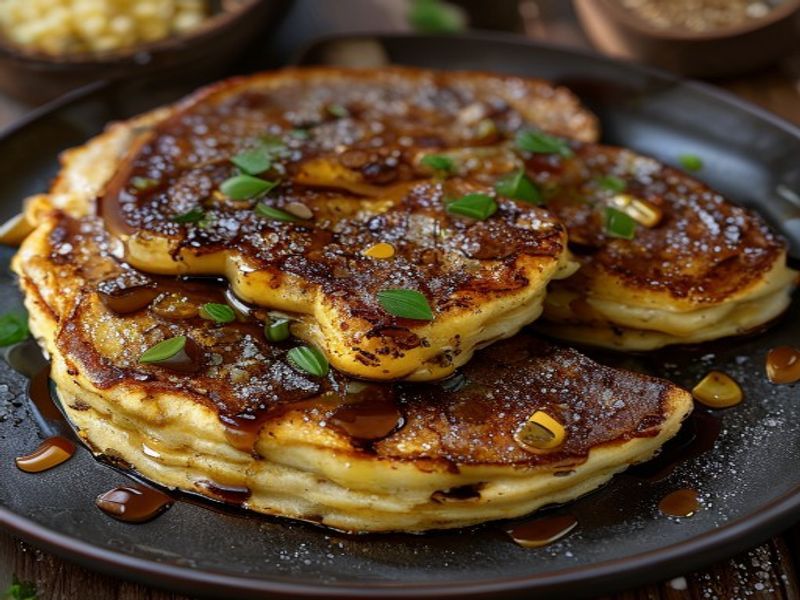
Portion 3 pancakes per serving for a balanced macronutrient profile. Arrange them slightly staggered on warmed ceramic plates to showcase the crispy pancake edges. Drizzle the cardamom honey syrup generously across the top, allowing it to pool slightly in the center. Complement with sweet breakfast toppings such as toasted pecans, fresh blackberries, or a quenelle of Greek yogurt. The acidity and fat from the yogurt cut through the syrup’s richness, creating a rounded flavor profile. For beverage pairings, serve with black coffee or a lightly oaked Chardonnay to mirror the toasted notes.
FAQ
Can I prep the batter ahead of time?
No. The chemical reaction between baking powder, baking soda, and the liquid begins immediately upon mixing. Storing mixed batter for more than 30 minutes depletes 60% of the leavening power, producing dense results. Prepare dry and wet components separately, then combine and cook immediately.
How do I know when the pancakes are fully cooked through?
Insert an instant-read thermometer into the center of the thickest pancake. It should register 190°F / 88°C. Visually, the center will feel springy when gently pressed with a fingertip, and the crumb will appear uniformly set without translucent wet streaks.
Can I use frozen cornmeal or pre-ground flour blends?
Yes, but cornmeal must be brought to room temperature (70°F / 21°C) before incorporation. Cold cornmeal absorbs liquid unevenly, creating gritty pockets. If using a pre-ground gluten-free blend, verify it contains a starch-to-protein ratio of 60:40 for optimal lift in griddle-cooked pancakes.
My edges aren’t getting crispy. What went wrong?
Insufficient surface heat or excessive batter thickness. Verify the griddle reads 350°F / 177°C before each batch. If your cornmeal is particularly fine, reduce the milk by 1 tablespoon to tighten the batter, which encourages faster edge set and caramelization.
For consistent temperature control during easy weekend breakfast service, I recommend using a professional-grade infrared thermometer like the ThermoWorks IR Thermometer to verify your griddle surface before each batch. A heavy-duty 14-inch griddle like the Lodge Cast Iron Griddle retains heat evenly, eliminating hot spots that cause uneven browning.
*As an Amazon Associate I earn from qualifying purchases.